
Anúncios
Fusion energy stands at the threshold of transforming humanity’s energy landscape, promising clean, abundant power that could redefine our civilization’s future.
🌟 The Dawn of a New Energy Era
For decades, scientists have dreamed of harnessing the same power that fuels our sun. Fusion energy represents not just an incremental improvement in energy technology, but a quantum leap toward solving humanity’s most pressing challenges: climate change, energy security, and sustainable development. Unlike fossil fuels that pollute our atmosphere or current nuclear fission that produces long-lived radioactive waste, fusion offers a pathway to virtually limitless clean energy.
Anúncios
The physics behind fusion is elegantly simple yet devilishly difficult to execute. When light atomic nuclei combine under extreme temperatures and pressures, they release tremendous amounts of energy. This process powers every star in the universe, and replicating it on Earth has been called one of humanity’s greatest scientific challenges.
Recent breakthroughs have shifted fusion from the realm of distant possibility to imminent reality. Major research facilities worldwide are reporting unprecedented achievements, with some experiments producing more energy than consumed for the first time in history. This milestone, known as net energy gain, marks a turning point in the fusion journey.
Anúncios
Understanding the Fusion Fundamentals ⚛️
Fusion energy creation requires forcing atomic nuclei to overcome their natural electromagnetic repulsion. The most promising fusion reaction involves deuterium and tritium, two isotopes of hydrogen. When these nuclei fuse at temperatures exceeding 100 million degrees Celsius, they create helium and release a neutron carrying enormous kinetic energy.
This temperature requirement presents the first major challenge. At such extreme conditions, matter exists as plasma—a fourth state where electrons separate from nuclei. Containing and controlling this plasma demands innovative engineering solutions that push the boundaries of materials science and electromagnetic theory.
The fuel sources themselves offer remarkable advantages. Deuterium can be extracted from seawater, where it exists naturally in abundance. One liter of seawater contains enough deuterium to produce energy equivalent to 300 liters of gasoline. Tritium, while rarer, can be bred within the fusion reactor itself using lithium, another relatively abundant element.
The Magnetic Confinement Approach
Tokamaks represent the most developed fusion technology. These donut-shaped chambers use powerful magnetic fields to confine plasma away from physical walls. The largest tokamak under construction, ITER in France, embodies decades of international collaboration and represents a $20 billion investment in fusion’s future.
Stellarators offer an alternative magnetic confinement design with twisted, complex geometries. While more challenging to build, stellarators promise better plasma stability and continuous operation. Germany’s Wendelstein 7-X stellarator has demonstrated impressive plasma confinement times, validating this approach.
Inertial Confinement: A Different Path
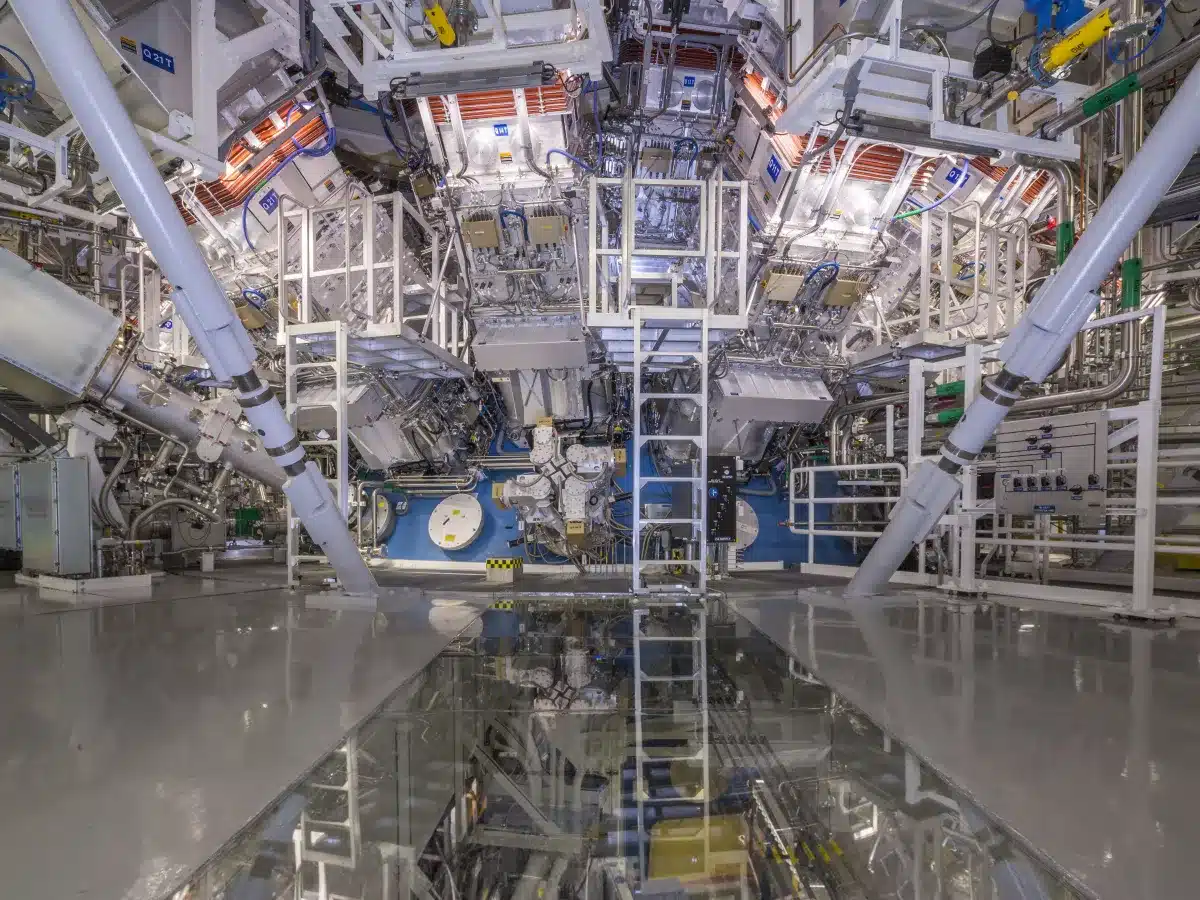
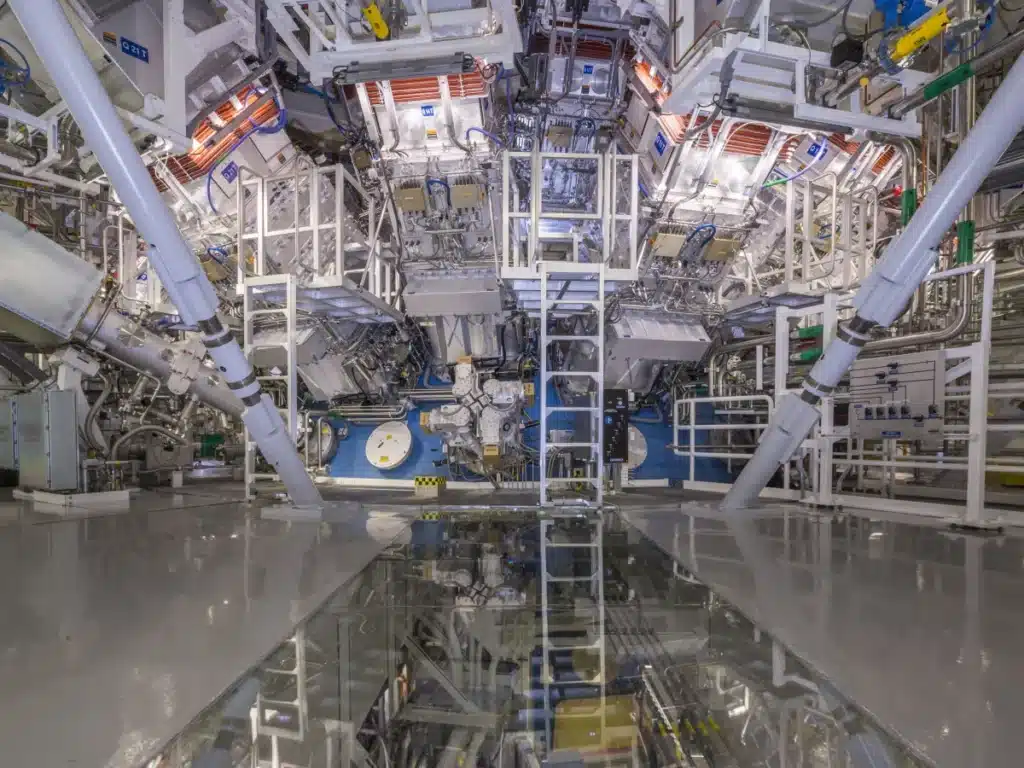
Rather than magnetic fields, inertial confinement fusion uses powerful lasers or ion beams to compress tiny fuel pellets. The National Ignition Facility in California achieved a historic breakthrough in December 2022, producing fusion reactions that generated more energy than the lasers delivered to the target.
This achievement demonstrated fusion ignition is possible, though significant engineering challenges remain before this can become a practical power source. The laser system consumed far more energy than the fusion reaction produced, highlighting the gap between scientific breakthrough and commercial viability.
🚀 Recent Breakthroughs Accelerating Progress
The fusion landscape has transformed dramatically in recent years. Scientific achievements once considered decades away are now reality, while private sector investment has exploded. More than 35 private fusion companies are racing to commercialize various fusion approaches, backed by billions in venture capital and government support.
Commonwealth Fusion Systems, a spinout from MIT, is building SPARC, a compact tokamak using high-temperature superconducting magnets. These advanced magnets enable smaller, less expensive reactors while achieving the necessary plasma confinement. The company aims to demonstrate net energy gain and pave the way for their commercial reactor design, ARC.
TAE Technologies has developed a unique beam-driven field-reversed configuration approach. Their latest reactor, nicknamed “Copernicus,” has achieved plasma temperatures exceeding 75 million degrees Celsius and demonstrated impressive stability. The company projects commercial fusion power plants operating by the 2030s.
Helion Energy pursues a pulsed fusion approach using field-reversed configuration. Their technology aims to directly convert fusion energy to electricity, potentially achieving higher efficiency than conventional steam turbine systems. Microsoft has already signed an agreement to purchase electricity from Helion’s planned fusion facility.
The Environmental Promise 🌍
Fusion energy’s environmental credentials are exceptional. The reaction produces no greenhouse gases, only helium as a byproduct—an inert, valuable gas used in various applications. Unlike fossil fuels that release carbon dioxide, sulfur, and other pollutants, fusion offers truly clean energy at the point of generation.
The radioactivity question deserves careful examination. While fusion reactors aren’t radioactive in the way fission reactors are, neutron bombardment activates reactor materials. However, these activated materials have much shorter half-lives than fission waste, typically becoming safe within decades rather than millennia. Careful material selection can minimize this activation further.
Fusion’s fuel efficiency is staggering. A single fusion power plant would require only a few hundred kilograms of fuel annually—deuterium extracted from seawater and lithium for tritium breeding. Compare this to coal plants burning millions of tons of fuel, or even solar farms requiring vast land areas, and fusion’s resource efficiency becomes apparent.
Safety Advantages Over Traditional Nuclear
Fusion reactors cannot experience runaway reactions or meltdowns. The plasma contains only enough fuel for seconds of operation, and any disruption immediately stops the fusion process. There’s no possibility of a Chernobyl or Fukushima-type accident because the fundamental physics prevents such scenarios.
Fusion produces no materials suitable for weapons proliferation. While tritium has weapons applications, the quantities in a fusion reactor are minimal and heavily monitored. The technology itself doesn’t enable weapons development in the way uranium enrichment does.
⚡ Technical Challenges and Solutions
Despite remarkable progress, significant obstacles remain before fusion becomes commercially viable. These challenges span materials science, plasma physics, engineering, and economics.
- Materials durability: First wall materials facing the plasma must withstand intense neutron bombardment, extreme heat, and electromagnetic stress simultaneously
- Tritium breeding: Self-sufficient tritium production within reactors requires solving complex blanket design challenges
- Plasma stability: Controlling plasma turbulence and instabilities that can disrupt confinement demands sophisticated real-time control systems
- Economic competitiveness: Fusion must achieve costs competitive with renewables plus storage to gain market acceptance
- Regulatory frameworks: New licensing approaches specific to fusion’s unique safety profile need development
Advanced materials research is addressing durability challenges. Tungsten-based composites, silicon carbide ceramics, and novel steel alloys show promise for first wall applications. Some researchers explore liquid metal walls that could self-heal and handle extreme heat fluxes.
Artificial intelligence and machine learning are revolutionizing plasma control. These systems can predict and prevent plasma instabilities milliseconds before they occur, maintaining stable confinement far better than traditional control methods. Google’s DeepMind has collaborated with fusion researchers to develop AI systems that optimize plasma shapes and stability.
🏭 The Path to Commercial Deployment
The journey from laboratory demonstration to commercial power plants involves multiple intermediate steps. Most fusion companies envision a progression from proof-of-concept devices to pilot plants to demonstration facilities before full commercial deployment.
ITER, scheduled to begin deuterium-tritium operations in the 2030s, will demonstrate sustained fusion at power plant relevant scales. This international project serves as a crucial stepping stone, proving technologies and operational procedures needed for commercial reactors. Its successor, DEMO, aims to actually generate electricity for the grid.
Private companies are pursuing faster timelines through smaller, more focused efforts. Rather than building one massive demonstration facility, they’re iterating through multiple smaller devices, incorporating lessons learned into each generation. This approach mirrors successful innovation patterns from other industries.
Economic Considerations and Market Readiness
Fusion’s economic case depends on capital costs, operational expenses, and electricity pricing. Early fusion plants will likely be expensive, but costs should decrease as the technology matures—a pattern seen with every new energy technology. Some projections suggest fusion electricity could achieve costs around $50-100 per megawatt-hour, competitive with other low-carbon sources.
The baseload power capability gives fusion advantages over intermittent renewables. Fusion plants could operate continuously, providing reliable electricity regardless of weather conditions. This complements renewable energy rather than competing with it, with fusion filling gaps when solar and wind aren’t available.
Fusion’s high power density means relatively small facilities can generate enormous power. A fusion plant occupying a few acres could produce gigawatts of electricity, far exceeding the power density of renewable alternatives. This becomes crucial in regions with limited land availability or where energy demands are concentrated.
🌐 Global Competition and Collaboration
Fusion research represents both competition and collaboration on a global scale. While nations and companies race to achieve commercial fusion first, the scientific community maintains strong collaborative traditions. Knowledge sharing accelerates progress, even as commercial interests drive parallel development paths.
China has invested heavily in fusion research, operating multiple experimental reactors and contributing to ITER. Their EAST tokamak has achieved record plasma temperatures and confinement times. Chinese researchers aim for fusion demonstration plants by the 2030s or early 2040s.
The United Kingdom recently announced plans for STEP (Spherical Tokamak for Energy Production), targeting grid-connected fusion power by the early 2040s. This spherical tokamak design offers potential advantages in compactness and efficiency compared to conventional tokamaks.
The United States has embraced a public-private partnership model. Government funding supports fundamental research while private companies pursue commercialization. This approach leverages public resources for high-risk basic research while enabling entrepreneurial innovation in engineering and deployment.
Integration with Future Energy Systems 🔋
Fusion won’t exist in isolation but will integrate with broader energy infrastructure. Hybrid systems combining fusion with renewables and storage could provide optimal reliability and cost-effectiveness. Fusion’s role would evolve as energy systems mature and climate goals tighten.
Fusion could enable abundant clean energy for industrial processes currently difficult to decarbonize. High-temperature heat from fusion reactors could produce hydrogen, synthesize carbon-neutral fuels, or power energy-intensive manufacturing. These applications might prove even more valuable than electricity generation alone.
Distributed fusion in the longer term could reshape energy infrastructure. While first-generation plants will likely be large centralized facilities, future compact reactors might enable more distributed generation. This could improve energy security and reduce transmission infrastructure needs.
🎯 Timeline Expectations and Reality Checks
Fusion has long suffered from over-optimistic predictions. The joke that “fusion is 30 years away and always will be” reflects decades of delayed timelines. However, recent progress suggests this time might genuinely be different. Multiple credible pathways toward commercial fusion are advancing rapidly with substantial private and public investment.
Realistic expectations suggest demonstration fusion power plants in the 2030s, with early commercial deployment in the 2040s. Some aggressive private ventures claim earlier timelines, potentially delivering fusion electricity to the grid in the late 2020s or early 2030s. Skepticism remains warranted, but the accelerating pace of achievement is undeniable.
The transition from first commercial plants to widespread adoption will span decades. Even optimistic scenarios don’t see fusion becoming the dominant energy source before the 2050s or 2060s. This timeline means fusion cannot solely solve climate change—aggressive deployment of current clean technologies remains essential. Fusion represents the energy solution for mid-century and beyond.
Preparing for the Fusion Future 🔮
Realizing fusion’s promise requires action beyond the laboratory. Workforce development must accelerate to provide the skilled engineers, physicists, and technicians needed. Educational programs should expand, and industry-academia partnerships must strengthen to build the fusion workforce.
Supply chains for specialized fusion components need development. Manufacturing capabilities for high-temperature superconductors, advanced ceramics, and precision components must scale up. Creating these supply chains represents significant economic opportunities for regions that invest early.
Public engagement and education about fusion remains crucial. Misconceptions about nuclear technology in general could hinder fusion deployment despite its vastly different safety profile. Transparent communication about fusion’s benefits, limitations, and safety characteristics will build the social license needed for widespread deployment.
Regulatory frameworks appropriate to fusion’s unique characteristics require development now. Treating fusion like fission nuclear power applies inappropriate restrictions, while inadequate regulation could compromise safety. Several countries are developing fusion-specific regulatory pathways that recognize the technology’s distinct features.
Beyond Earth: Fusion’s Cosmic Applications 🚀
Fusion’s potential extends beyond terrestrial energy supply. Space exploration and colonization depend fundamentally on advanced propulsion and power systems. Fusion rockets could enable much faster interplanetary travel, reducing journey times to Mars from months to weeks. Compact fusion reactors could power lunar or Martian bases with reliable energy independent of solar panels.
The same fusion technology being developed for Earth could unlock the solar system. The energy density of fusion fuel vastly exceeds chemical rockets, and fusion doesn’t require carrying oxidizer. These advantages could transform humanity’s reach into space, making the exploration and utilization of our cosmic neighborhood feasible.
The Innovation Ecosystem Driving Progress 💡
The current fusion renaissance results from convergent technological advances across multiple fields. High-temperature superconductors enable smaller, more powerful magnets. Advanced computing allows sophisticated plasma modeling and control. Additive manufacturing produces complex reactor components previously impossible to fabricate. Machine learning optimizes plasma behavior in real-time.
This technological convergence has accelerated fusion progress beyond what incremental advances in any single area could achieve. The fusion community has effectively leveraged innovations from other industries, applying them to fusion’s unique challenges. This cross-pollination of technologies exemplifies how breakthrough innovations often emerge at the intersection of multiple disciplines.
Investment dynamics have shifted dramatically. Where fusion was once solely government-funded research, private capital now flows abundantly. Venture capitalists, tech billionaires, and strategic corporate investors recognize fusion’s transformational potential. This private funding enables risk-taking and rapid iteration that complement government research programs.
Addressing the Stakes: Why Fusion Matters Now ⏰
Climate change demands urgent action with every available tool. While fusion won’t solve the immediate crisis, it represents an essential component of long-term climate solutions. The investments and research conducted now determine whether fusion arrives in time to facilitate deep decarbonization in mid-century when climate challenges may intensify.
Energy abundance could transform human civilization. Current clean energy technologies, while improving rapidly, face fundamental constraints around intermittency, land use, and materials requirements. Fusion offers a path to truly abundant clean energy without these constraints, potentially enabling prosperity and development at unprecedented scales.
The pursuit of fusion drives scientific and technological progress with benefits beyond energy. Advanced materials, plasma physics understanding, superconductor development, and numerous other innovations emerging from fusion research find applications throughout the economy. Fusion research represents an investment in fundamental scientific and engineering capabilities.
As we stand at this pivotal moment in fusion energy development, the next decade will prove decisive. The combination of scientific breakthroughs, engineering advances, private sector dynamism, and growing climate urgency creates unprecedented momentum. Fusion energy transitions from distant dream to approaching reality, promising to unleash tomorrow’s power and fundamentally transform humanity’s energy future. The fusion frontier awaits, and the journey toward harnessing the stars’ power continues accelerating toward its ultimate destination: abundant, clean, safe energy for all.
